Draw Clash Hero
Iron GlitchAction
3.83.00 Reviews
- Version
- 0.9
- Installs
- 500.00K
- Age Rating
- Mature 17+
Screenshots
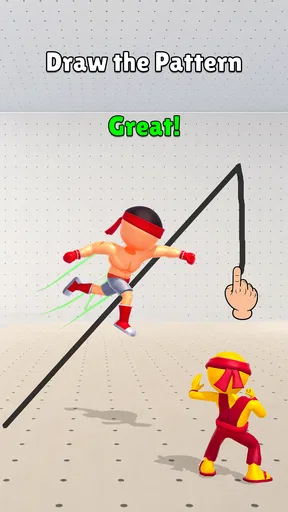
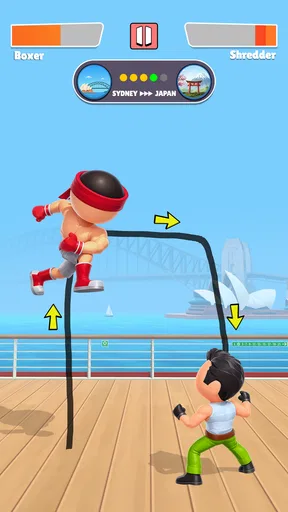
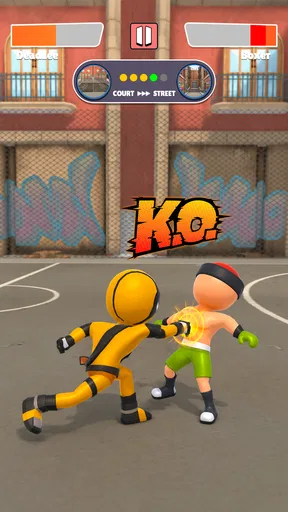
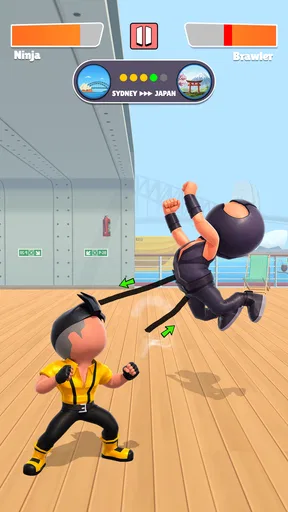
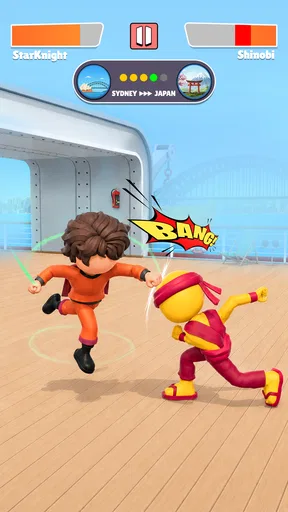
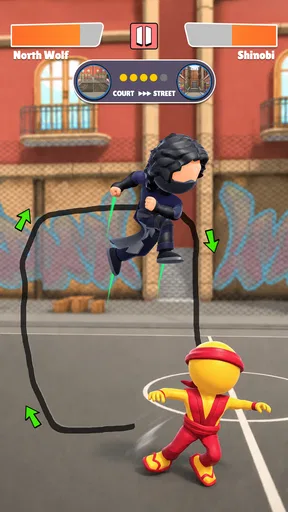
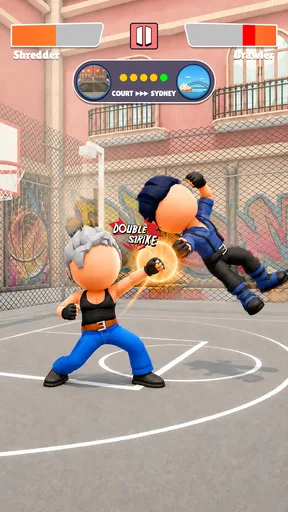
Our Review of Draw Clash Hero
 Analysis by Appyee
Draw Clash Hero is the kind of action game that immediately asks for your attention rather than promising a long, complicated campaign. Its central idea is simple: you draw the movement you want, then watch that plan turn into a fight against enemies. I spent time with it as a quick, gesture-focused experience, and my first impression is that the drawing mechanic gives ordinary action encounters a more deliberate feel. You are not only reacting to what appears on screen; you are trying to decide how your hero should move before the clash unfolds.
That makes it an interesting choice for players who enjoy short bursts of interaction and want something more involved than tapping the same attack button. At the same time, the concept places a lot of pressure on how accurately and comfortably the game reads your gestures. If you prefer traditional virtual controls, or if you want a large action game with a deep progression system, this may not be the right fit. For me, its appeal comes from the unusual control idea, not from trying to compete with a full-scale console-style adventure.
How the drawing-based combat feels in practice
The most important thing to understand is that the drawing is not just decoration. It is the part of the interaction that gives each encounter its identity. I found myself thinking about direction, timing, and the shape of a move instead of simply pressing an attack command. That extra step can make a basic enemy encounter feel like a small puzzle, especially when I wanted to move aggressively without losing control of the hero.
The best way to approach a fight is to treat every gesture as a short instruction. Rather than drawing an elaborate route immediately, I would begin with a clear, compact movement and see how the hero responded. This made the action easier to read and reduced the frustration that comes from trying to plan too much at once. Short, intentional drawings are more useful than complicated scribbles, particularly when the screen becomes busy.
That is also where the game’s main trade-off appears. Drawing gives the combat a personal touch, but it can feel less direct than a conventional action layout. In a familiar beat-’em-up, I know exactly which button triggers an attack or dodge. Here, I have to translate my intention into a gesture, and the result depends on how clearly I draw it. Players who enjoy experimenting with controls will probably appreciate that relationship. Players who want immediate precision may need patience before the system feels natural.
I would not describe this as a passive game despite its approachable premise. The drawing mechanic encourages planning, but the action still depends on reading the situation and making sensible choices. I found the experience more enjoyable when I stopped trying to make every move perfect. A practical gesture that gets the hero into a safe position is often better than an ambitious line that looks clever but leaves me poorly placed for the next exchange.
A useful routine for new players
My recommendation for a first session is to spend a few encounters learning the game’s response instead of rushing toward the most dramatic movement. Notice how much space your drawing covers, how quickly the hero follows it, and whether a long gesture leaves you exposed. This creates a personal sense of timing that is more valuable than copying a single “best” movement pattern.
Another helpful habit is to leave visual room around the gesture. When I drew too close to other on-screen elements, it became harder to judge whether I had made the move I intended. Keeping the line simple and away from clutter made the action easier to follow. This is a small adjustment, but it matters because the whole game is built around turning a finger movement into a combat decision.
I also found that the drawing system works best when I use it as a way to control tempo. A fast, direct move can help maintain pressure, while a more cautious line gives me a moment to understand what is happening. That makes the game feel less like random swiping and more like a conversation between my plan and the enemy’s position. The system is at its most satisfying when the gesture feels chosen rather than accidental.
Who will get the most from it
This is a good match for someone who wants an action game that can be understood quickly but still asks for active participation. It suits players who enjoy gesture controls, experimental combat ideas, and short sessions where the main pleasure comes from improving how they handle the controls. It may also appeal to people who have become tired of action games that reduce every encounter to repeated taps and automatic attacks.
I can imagine using it during a short break when I want something more engaging than a puzzle but less demanding than a large role-playing game. The drawing mechanic gives even a brief session a clear focus: decide on a move, see how it works, and adjust the next attempt. That loop is easy to pick up without requiring me to remember a complicated collection of commands.
However, I would skip it if my priority were a broad narrative, extensive character customization, or a carefully documented competitive system. The confirmed store information presents it as an action game centered on drawing moves and fighting enemies, so I approached it for that core interaction rather than expecting the feature depth of a major franchise. Its strength is its central idea, and that also defines its limits.
How it compares with familiar action games
Compared with a standard side-scrolling fighter, Draw Clash Hero gives more control to the player’s drawing rather than separating movement and attacks into fixed buttons. That makes it feel more experimental and less immediately predictable. A traditional fighter is usually better when I want a known control scheme and consistent input response. This game is more appealing when I want the act of planning movement to be part of the entertainment.
It also differs from auto-battle games. In an auto-battle format, the main decisions often happen before the fight, while the encounter itself can feel distant. Here, the gesture keeps me involved in the moment. I am not simply watching a result generated by a loadout; I am trying to guide the hero through the encounter. That involvement is a real advantage, although it means the game depends more heavily on comfortable touch input.
Against large action adventures, the comparison is less favorable in terms of scope. Those games can offer expansive environments, detailed storytelling, and many layers of progression. Draw Clash Hero is more focused. I would choose it for its unusual combat premise, not as a replacement for a content-heavy adventure. Thinking of it as a compact action experiment gives a much fairer picture of what it is trying to do.
Current state, version context, and what I would watch next
The game comes from Iron Glitch and is currently listed as version 0.9. That version number is important context: I see the present release as an evolving foundation rather than a finished statement of everything the game could become. The core concept is already clear, but an early version naturally makes me pay attention to how the controls, enemy variety, and overall pacing develop over time.
For someone discovering it now, the practical benefit is that the central mechanic is easy to understand without a long explanation. The practical risk is that the experience may feel narrower than a player expects from a mature action title. I would approach it with curiosity and reasonable expectations, focusing on whether the drawing-based combat is enjoyable for me rather than assuming that a later update will solve every current irritation.
The release is dated Jun 30, 2026, and the game supports devices running Android 7.1 or later. That broad operating-system requirement makes it approachable for people using older compatible phones, although the real comfort of drawing gestures will still depend on screen size, touch responsiveness, and how much space the display gives the action. On a smaller screen, I would be especially careful to use compact movements and avoid drawing across busy areas.
Existing users should pay attention to how future changes affect the relationship between drawing and combat. A useful update would not merely add more content; it would make the gesture system easier to understand, more consistent, or more expressive without taking away its simplicity. If the game evolves, I would want improvements that reward careful input while still letting a new player learn the basics quickly.
There are also important gaps from a reviewer’s point of view. The concept tells me why the game is different, but it does not automatically guarantee long-term variety. Repeating similar encounters could make the drawing mechanic feel less fresh if the challenges do not continue to test it in different ways. That is why I would judge its staying power by the quality of the situations it creates, not only by the novelty of drawing a move during the first few sessions.
Another potential friction point is accessibility of control. Gesture-based play can be intuitive for one person and tiring or imprecise for another. Someone with limited touch accuracy may find a conventional button layout easier. Even for players without that concern, long sessions could become less comfortable if every encounter requires concentrated finger movement. I would treat this as a game to sample in short sessions first, then decide whether the control style remains enjoyable.
The mature age rating of 17+ is another reason to check whether the tone suits the person using the device. Parents looking for a general family action game should not choose it casually, and younger players are not the intended audience. The rating is part of the decision, not a minor label to ignore when the game’s drawing mechanic sounds accessible.
It is free to download, which lowers the barrier to trying the idea for yourself. Still, free does not automatically mean it will be the best use of your time. I would give it a fair test by playing long enough to learn the gesture rhythm, then asking whether I am enjoying the decisions or merely repeating movements. That distinction matters more here than the absence of an upfront price.
The audience response is fairly modest but useful as a general signal: the game has passed half a million installs, with an average rating of 3.8 from around 540 ratings. I read that as evidence of real interest alongside a mixed reception, rather than as a reason to assume universal appeal. The small number of written reviews means I would rely more on my own hands-on impression of the controls than on a few short comments from other players.
What I would watch in future development is not just a larger number of enemies. I would look for clearer feedback after each drawing, encounters that make different movement styles worthwhile, and a smoother learning curve for people who do not immediately understand how much to draw. Those changes would strengthen the game without turning it into something else. The best evolution would preserve the direct, tactile identity while giving skilled players more meaningful reasons to refine their technique.
For an everyday example, imagine having a few minutes before a train arrives. A conventional action game might require a longer commitment or a complicated setup, while this one gives me a focused task: enter a fight, draw a movement, react to the result, and try a better line. That makes it convenient for brief play. The downside is that a poor touch moment can feel more annoying when the session is short, because I have less time to recover and settle into the controls.
My final view is positive but measured. Draw Clash Hero has a distinct reason to exist: it turns movement planning into the main action instead of hiding it behind a familiar button scheme. I enjoyed the moments when a simple gesture matched my intention and carried the hero cleanly through a clash. I was less convinced when the input felt harder to interpret than the situation deserved.
I would recommend it to curious action players who want to try a gesture-led combat idea and are comfortable with an experience that is still developing. I would not recommend it as the first choice for someone seeking a deep, polished alternative to a major action adventure, nor for anyone who strongly prefers fixed controls. Its value is in the feel of drawing a decision and immediately seeing that decision matter. If that sounds appealing, the free entry point makes trying it sensible; just approach version 0.9 as a focused work in progress and judge the game by the quality of its core interaction.
Verdict
Strengths of Draw Clash Hero
- Simple controls make it easy for new players to start drawing and fighting.
- Quick battles are well suited to short gaming sessions.
- Hero customization adds variety to the visual style of each match.
- The cartoon presentation is colorful and easy to understand.
- Offline play may be convenient when an internet connection is unavailable.
Limitations of Draw Clash Hero
- Gameplay can become repetitive after mastering the main drawing mechanics.
- Some stages may feel unbalanced, especially against stronger opponents.
- Ads can interrupt the experience or appear frequently between battles.
- Limited strategic depth may disappoint experienced action game players.
- Progression can feel slow without upgrades or additional in-app purchases.
Similar Picks in This Category
View All
Temple Run 2: Endless Escape
Imangi Studios4.1

PUBG MOBILE
Level Infinite4.3

Free Fire: 9th Anniversary
GARENA INTERNATIONAL I4.4

Talking Tom: Hero Dash Run
Outfit7 Limited4.3

slither.io
Lowtech Studios3.9

Sniper 3D:Gun Shooting Games
Wildlife Studios4.6
Frequently Asked Questions
What is Draw Clash Hero and how does the gameplay work?
Draw Clash Hero is a casual action game built around drawing your own character’s equipment before entering a fight. You normally sketch weapons, shields, or other useful shapes, then watch your hero use the design in short battles. The appeal comes from combining simple drawing controls with quick combat, experimentation, and progressively more demanding opponents.
Is Draw Clash Hero free to download and play?
Draw Clash Hero can generally be downloaded and played without an upfront purchase, although the exact availability of advertisements, optional purchases, and premium content may vary by device and region. Players should check the store listing before installing, especially if they want to know whether removing ads, unlocking items, or receiving extra resources requires a payment.
Does Draw Clash Hero require an internet connection?
Many of the game’s basic battles and drawing challenges may be playable offline, which makes it suitable for short sessions while traveling or when Wi-Fi is unavailable. However, certain features can depend on an internet connection, including advertising rewards, cloud-related services, updates, leaderboards, or purchases. It is best to launch the game online first and review its behavior.
Is Draw Clash Hero suitable for children?
Draw Clash Hero is generally easy to understand because its controls focus on drawing and tapping rather than complicated combinations. Nevertheless, parents should review the game’s age rating, advertising, in-app purchase options, and privacy information before allowing a child to play. Some designs or combat animations may also be more appropriate for older children than very young users.
What should I know about performance, controls, and in-app purchases?
The game is designed for short, accessible matches, and its drawing system is usually more enjoyable on a device with a responsive touchscreen and enough storage for updates. Older phones may experience slower loading or occasional performance issues. Players should also watch for optional purchases and reward advertisements, since progression may be influenced by how often these features are used.
Play our best games!


